

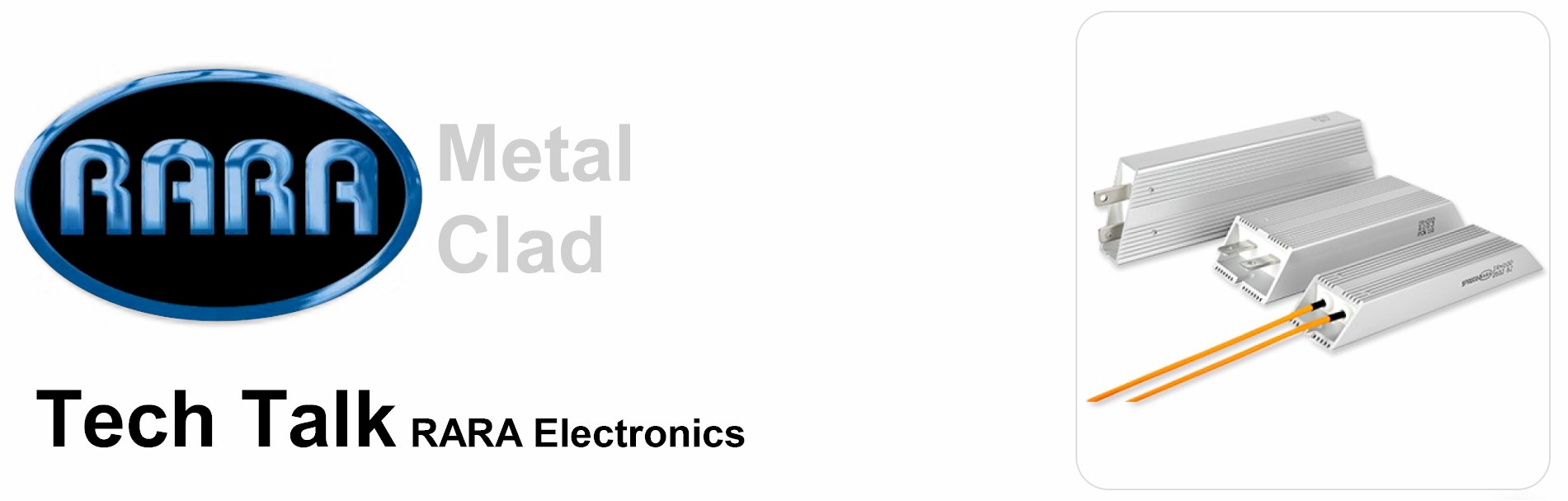
Metal Clad Resistors: Construction, Applications,
and High-Power Performance Guide
Metal clad resistors are among the most reliable and versatile components used in modern power electronics. Known for their durability, heat dissipation, and high power handling, these resistors are widely used in industrial, automotive, and renewable energy systems.
In this guide, we’ll explore how metal clad resistors are built, where they are used, and why they are essential in demanding electrical applications.
What Are Metal Clad Resistors?
Metal clad resistors (also called aluminum-housed or wirewound power resistors) are high-power resistors enclosed in a rugged metal casing—typically aluminum.
They are designed to dissipate large amounts of heat efficiently while maintaining stable electrical performance.
RARA’s metal clad resistor range includes models such as:
RH10C (10W cement encased)
RH / FRH (15W–50W aluminum housed)
URH (20W–100W UL-rated)
IRN / ULN / IRF / ULF (50W–500W high power)
Automotive-grade ARN series (up to 150W)
These products cover a wide range of resistance values, tolerances, and thermal characteristics.
Construction of Metal Clad Resistors
Metal clad resistors are typically wirewound resistors inside an aluminum enclosure, optimized for thermal management.
Key Construction Elements
1. Resistive Element (Wirewound Core)
Made from alloys such as nichrome or similar resistive wire
Wound around a ceramic core for insulation and thermal stability
Provides precise resistance and excellent stability under load
Wirewound designs are known for:
High accuracy
Low noise
Strong overload capability
2. Ceramic Insulation Core
Electrically isolates the resistive wire
Provides mechanical strength and heat resistance
3. Heat-Resistant Cement Filling
Encapsulates the wire element
Protects against vibration, dust, and mechanical stress
Improves thermal conduction to the outer casing
This construction makes the resistor resistant to harsh environments
4. Aluminum Housing (Metal Cladding)
Acts as a heat sink
Allows mounting directly to chassis or external heat sinks
Enables high power ratings (often up to hundreds or even thousands of watts)
5. Terminals / Connections
Screw terminals, leads, or busbars
Designed for high-current connections and easy installation
Key Features and Advantages
1. Excellent Heat Dissipation
The aluminum casing efficiently transfers heat away from the resistive element, allowing continuous operation at high power.
2. High Power Ratings
Metal clad resistors commonly operate from:
10W to 500W (standard)
Up to 1000W+ with proper heat sinking
3. Mechanical Durability
Resistant to vibration and shock
Suitable for industrial and automotive environments
4. Wide Resistance Range
Typical ranges include:
0.1Ω to several MΩ depending on model
5. Stability and Reliability
Low temperature coefficient (TCR)
Stable performance across wide temperature ranges
Applications of Metal Clad Resistors
Metal clad resistors are used wherever high power dissipation and reliability are required.
1. Motor Drives & Dynamic Braking
Used as braking resistors in VFD systems
Absorb excess energy when motors decelerate
Prevent damage to drive electronics
These are commonly used in:
Elevators
CNC machines
Industrial automation systems
2. Power Supplies & Inverters
Pre-charge and discharge circuits
Energy dumping in power electronics
Voltage balancing
Applications include:
Solar inverters
UPS systems
EV charging infrastructure
3. Load Banks & Testing Equipment
Simulate electrical loads for testing generators and power systems
Used in:
Data center testing
Generator commissioning
Battery discharge systems
4. Industrial Machinery
Current limiting
Snubber circuits
Heating and energy dissipation
Widely used in:
Manufacturing equipment
Robotics
Automated control systems
5. Automotive & EV Systems
Electric vehicle charging and braking
Battery management systems
High-power resistive loads
RARA’s AEC-Q200 automotive series reflects this growing demand
Example Product Configurations
Low Power (10W–50W)
Compact aluminum or cement-encased designs
Used in control circuits and smaller systems
Medium Power (50W–150W)
Chassis-mounted resistors
Used in industrial control and automation
High Power (150W–500W+)
Heavy-duty aluminum housings
Often mounted to heat sinks
Used in braking, load banks, and energy dissipation systems
Inductive vs Non-Inductive Designs
Metal clad resistors can be configured as:
Inductive (Standard Wirewound)
Higher power capability
Suitable for DC or low-frequency applications
Non-Inductive
Special winding techniques cancel inductance
Used in:
High-frequency circuits
Pulse applications
Snubber networks
Thermal Management Considerations
To maximize performance:
Mount resistors on metal surfaces or heat sinks
Use thermal compound if required
Ensure proper airflow
Without proper heat dissipation, power ratings must be derated.
Why Choose Metal Clad Resistors?
Metal clad resistors are the go-to solution for high-power, high-reliability applications because they offer:
Superior heat handling
Long operational life
Mechanical robustness
Flexible configurations
Broad application range
As industries shift toward electrification (EVs, renewable energy, automation), demand for these resistors continues to grow.
Conclusion
Metal clad resistors are a critical component in modern power electronics, combining rugged construction with high-performance electrical characteristics. From motor braking systems to renewable energy applications, their ability to safely dissipate energy makes them indispensable.
Manufacturers like RARA provide a wide range of configurations—from compact 10W units to high-power 500W+ chassis-mounted resistors—ensuring solutions for virtually any application.
Frequently Asked Questions About Metal Clad Resistors
What is a metal clad resistor?
A metal clad resistor is a high-power resistor enclosed in an aluminum housing designed for efficient heat dissipation. These resistors are typically wirewound and are used in applications requiring high reliability and power handling.
What are metal clad resistors used for?
Metal clad resistors are commonly used in:
Motor braking systems (dynamic braking)
Load banks and power testing equipment
Power supplies and inverters
Industrial automation systems
Electric vehicles and charging systems
They are ideal for absorbing and dissipating large amounts of electrical energy safely.
How do you mount a metal clad resistor?
Metal clad resistors should be mounted to a metal surface or heat sink to maximize heat dissipation. Using thermal compound between the resistor and mounting surface improves thermal conductivity and performance.
What is the difference between wirewound and metal clad resistors?
Wirewound refers to the internal construction (resistance wire wound around a core), while metal clad refers to the external aluminum housing. Most metal clad resistors use wirewound elements inside.
Are metal clad resistors inductive?
Standard metal clad resistors are inductive due to their wirewound design. However, non-inductive versions are available using special winding techniques for high-frequency or pulse applications.
What power ratings are available?
Metal clad resistors typically range from:
10W to 50W (compact designs)
50W to 150W (standard chassis mount)
150W to 500W+ (high-power applications)
Higher ratings are possible with proper heat sinking.
Do metal clad resistors require cooling?
Yes. Proper cooling is essential. Without adequate heat dissipation, the resistor must be derated. Mounting to a heat sink or metal chassis is strongly recommended.
What industries use metal clad resistors?
These resistors are widely used in:
Industrial automation
Renewable energy (solar, wind)
Automotive and EV systems
Power electronics and energy storage



Products & Downloads
Information & Schedule
100B-11L, 138 Cheongneung-
daero 410beon-gil,
Namdong-gu, Incheon
TEL : +82-70-4355-4327
FAX : +82-32-817-4328
Email: osm1@raraohm.com
daero 410beon-gil,
Namdong-gu, Incheon
TEL : +82-70-4355-4327
FAX : +82-32-817-4328
Email: osm1@raraohm.com
© 2026 RARA Electronics LLC